Being Present Is More Than Being in the Moment
The Profound Simplicity of The Power of Now
There is something profoundly simple about Eckhart Tolle’s The Power of Now. The idea that the present moment is the only moment we ever truly have can sound obvious at first, and yet the more I have sat with it, the more I have realised how deeply challenging it actually is.
We can be physically here, but mentally somewhere else. Replaying a conversation from yesterday. Worrying about something that may happen next week. Imagining what someone thinks of us. Rehearsing what we should have said. Trying to predict what might go wrong. Tolle writes about the mind’s tendency to pull us away from the present and into memories of the past or projections of the future.
One of the ideas that struck me most was his reminder that we are not our thoughts. We can observe a thought. We can notice it arise. And the moment we can see the thought, there is already a little space between us and it. That space can be powerful.
But as I reflected on my own life, I began to wonder whether being present goes even deeper than that.
When the Past Quietly Enters the Present
I realised there were many times in my past when I probably would have believed I was present. I was standing in the moment. I was making a decision. I was responding to what was happening in front of me. And yet, looking back now, I can see that sometimes it was not only the present moment I was responding to. I was seeing the present through the lens of my past.
As I have become more aware of myself, I can see patterns that I simply could not see at the time. The feeling of not being good enough. Wanting approval. Wanting to be loved. Wanting to be the “good girl”. Wanting to keep the peace. Wanting people to be happy with me.
These things influenced choices I made, sometimes without me consciously realising it. If someone seemed disappointed in me, perhaps I felt an immediate need to fix it. If someone was unhappy, perhaps I felt responsible for making things better. If there was conflict, perhaps keeping the peace felt safer than saying what I really thought or needed.
At the time, I may have thought I was simply responding to the situation in front of me. Now I can see that sometimes something much older was responding too.
And that has changed the way I think about presence.
We can be standing in the present moment while an old wound is quietly interpreting it for us. Someone’s disappointment can become I’ve done something wrong. Someone disagreeing with us can become They don’t like me. Conflict can become I need to make this go away. Setting a boundary can feel like I’m being selfish.
Suddenly, a decision that appears to be about today may actually be shaped by something that began a long time ago.
What Is Actually Happening Right Now?
One question I have found myself returning to is: What is actually happening in this moment, and what is my history telling me is happening?
I think there is enormous power in learning to tell the difference.
That does not mean every difficult emotion is coming from an old wound. Sometimes someone really has crossed a boundary. Sometimes anger is appropriate. Sometimes sadness needs to be felt. Sometimes discomfort is telling us something important. Being present does not mean becoming passive or convincing ourselves that everything is okay.
For me, it means trying to see what is here as clearly as possible. And sometimes that means recognising what we have unconsciously carried into the moment with us.
How Meditation Can Help Us Notice
This is one of the reasons meditation has become so meaningful to me.
Meditation gives us a place to practise noticing. A thought appears, and we notice it. An emotion moves through the body, and we feel it. The mind wanders into a story, and at some point, we realise we have wandered. Then we return. Again and again.
There is nothing dramatic about that practice, but over time, we can become more familiar with our inner landscape. We start recognising the thoughts we repeatedly return to. We notice where tension appears in the body. We may begin to see the stories that arise automatically when we feel rejected, criticised, uncertain or afraid.
And occasionally, in everyday life, a little bit of that awareness comes with us.
Instead of immediately reacting, there can be a moment of noticing. This feels familiar. Why is this affecting me so strongly? Am I responding to what is happening, or to what I fear it means? If I didn’t need this person’s approval, what would I choose? If I wasn’t trying to keep the peace, what would feel true for me?
That pause does not mean we will always make the perfect choice. But it gives us something we may not have had before: choice itself.
We Do the Best We Can With the Awareness We Have
Looking back on earlier versions of ourselves with the awareness we have now can be uncomfortable. It is easy to ask, Why didn’t I see that? Why did I allow that? Why didn’t I speak up? Why did I make that decision?
But I have come to feel differently about this.
I think we do the best we can with the awareness we have available to us at the time. Sometimes we simply cannot see something until we are ready to see it. And when awareness expands, the past can suddenly look very different.
That does not necessarily mean the person we were was foolish or weak. Perhaps that person was simply operating from the understanding, experiences and protective patterns they had at the time.
Now, with greater awareness, another choice becomes possible.
For me, that feels far more useful than regret.
I did the best I could with what I understood then. Now that I can see differently, I can choose differently.
Knowledge Can Be Learned. Wisdom Has to Be Lived.
And there is another part of this that feels important to me. I don’t regret the journey it took to understand these things.
Of course, there are experiences I would not choose to repeat. But I also know that I could not have arrived at some of the wisdom I have now without living through what came before.
We can gain knowledge from books. We can listen to teachers. We can study psychology, mindfulness, meditation or philosophy. We can understand an idea intellectually. But wisdom feels different.
Wisdom has to be lived.
It grows through experience. Through choices. Through relationships. Through getting things wrong. Through recognising patterns after we have repeated them more times than we would like. Through pain. Through healing. Through becoming curious about ourselves rather than constantly judging ourselves.
A book can tell us something is true. Life sometimes has to show us what that truth actually means.
Perhaps that is why certain teachings land differently at different stages of our lives. We can read the same words years apart and suddenly hear something entirely different. The words may not have changed. We have.
A Different Way of Understanding Presence
I still love the simplicity of Tolle’s invitation to return to now. Feel the breath. Feel the body. Notice the world around you. Observe the mind rather than becoming completely lost inside it.
But for me, presence has also come to mean something more.
It is not simply about being physically in this moment. It is about becoming aware of the filters through which we are seeing it. The old stories. The protective patterns. The beliefs about who we need to be in order to be accepted, safe or loved.
The more conscious those patterns become, the less power they have to silently make our decisions for us.
Perhaps healing does not mean the past disappears. Perhaps it means we become able to notice when the past has entered the room, and we no longer automatically hand it the steering wheel.
And in that space between an old pattern and our next response, something new becomes possible.
We can ask: What is true now? What do I need now? What would I choose from the person I am becoming, rather than the person I once needed to be?
That, for me, is becoming another way of understanding the power of now.
Creating Space Through Meditation
Meditation can be one way of developing this kind of awareness — learning to notice thoughts, emotions and patterns with a little more curiosity and a little less judgement.
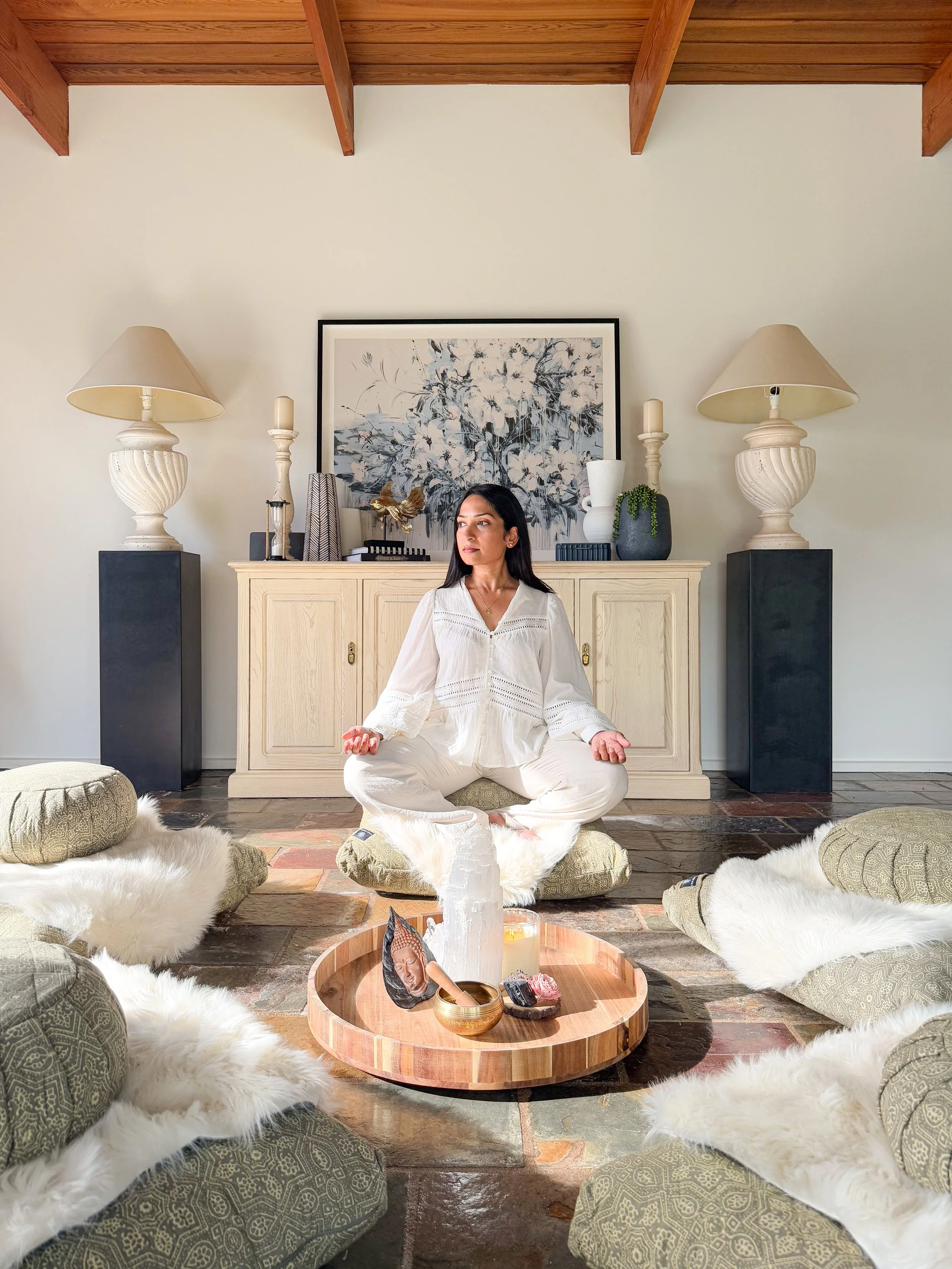
At State of Harmony in Glen Iris, I offer small-group and private meditation and mindfulness sessions, both in person and online, for people who would like to create more space to slow down, reconnect and become more aware of their inner experience.
Sometimes the first change is simply noticing.
And sometimes, from that noticing, a different way forward begins.
With warmth and gratitude,
Sithara